
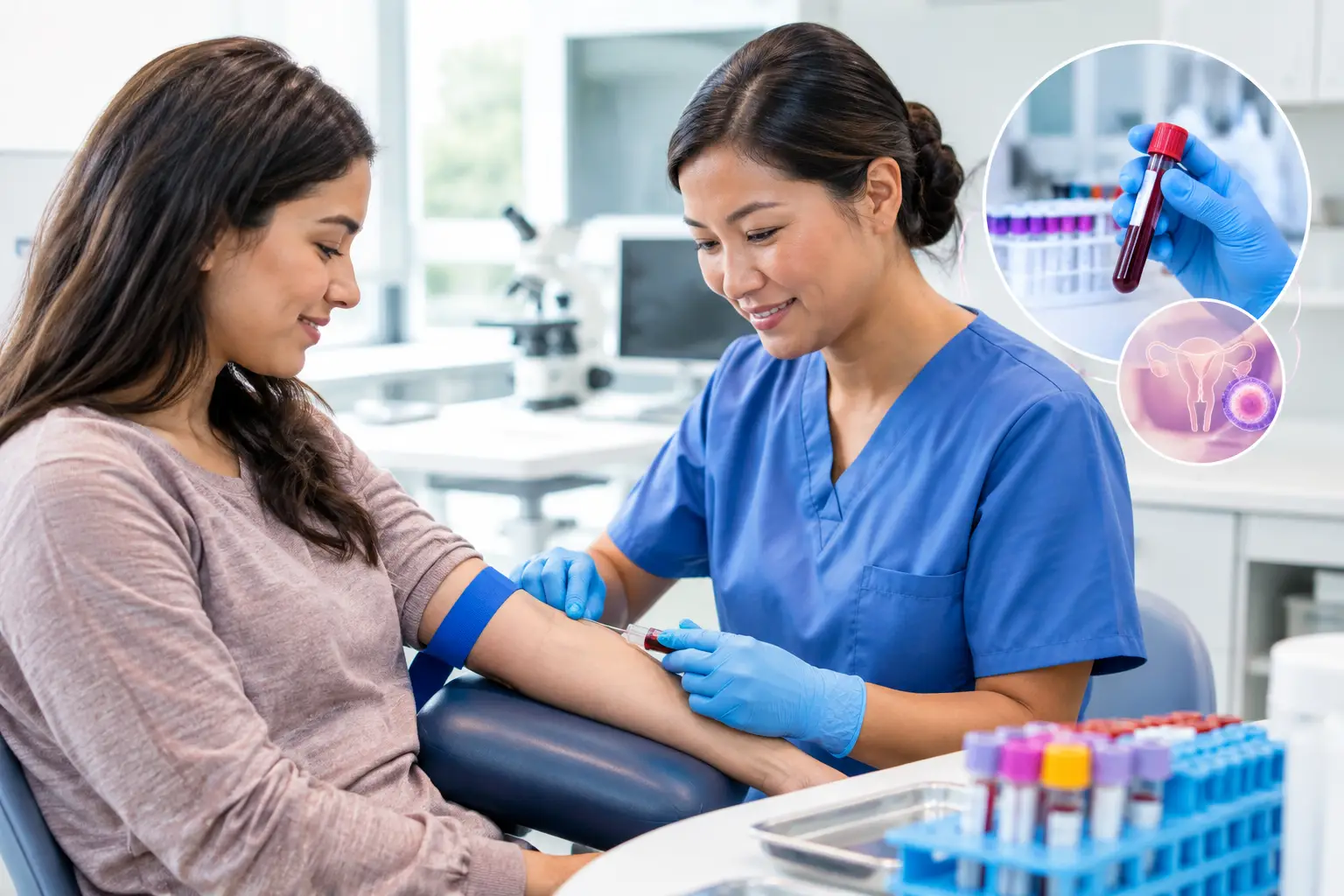
A fertility blood test result can answer a useful question, but rarely the whole question. Hormones can help explain whether ovulation may be occurring, how the thyroid or prolactin could be affecting reproductive function, and whether further assessment may be worthwhile. They cannot, on their own, confirm fertility or predict exactly how quickly someone will conceive.
For people trying for a pregnancy, blood tests for fertility can provide a practical starting point. The value comes from choosing the right markers, collecting the sample at the appropriate point in the menstrual cycle where required, and discussing results in the context of age, symptoms, medical history and how long you have been trying.
What blood tests for fertility may include
A fertility assessment is not one standard blood test. The markers selected depend on whether the focus is ovulation, ovarian reserve, menstrual irregularity, thyroid health, possible androgen excess, or male reproductive hormones.
For people with ovaries, commonly measured hormones include follicle-stimulating hormone (FSH), luteinising hormone (LH), oestradiol and anti-Müllerian hormone (AMH). FSH, LH and oestradiol are often interpreted together, particularly in the early part of the menstrual cycle. They can give clinicians information about signalling between the brain and ovaries, but results naturally vary between cycles.
AMH is often used as a marker of ovarian reserve, meaning the estimated remaining pool of follicles. It can be tested on most days of the cycle. A higher or lower result does not measure egg quality, guarantee a response to fertility treatment or determine whether natural conception is possible. Age remains a major factor in egg quality and reproductive potential.
Progesterone is another common test. When measured at the right time after ovulation, it can help indicate whether ovulation has likely taken place. A single result should be timed to the individual cycle rather than automatically taken on a fixed calendar day. For example, a person with a 35-day cycle may ovulate later than someone with a 28-day cycle.
Prolactin and thyroid-stimulating hormone (TSH) may also be relevant. Raised prolactin can interfere with ovulation, while thyroid dysfunction can affect menstrual regularity and pregnancy planning. Depending on the result, free thyroxine (free T4) and thyroid antibodies may be considered as part of a clinician-led assessment.
Where symptoms suggest polycystic ovary syndrome (PCOS) or another hormone-related condition, a clinician may also request testosterone, sex hormone-binding globulin (SHBG), dehydroepiandrosterone sulphate (DHEAS) or related markers. These results need careful interpretation because medicines, supplements and the timing of testing can affect them.
For people producing sperm, blood tests may include testosterone, FSH, LH, prolactin, oestradiol and SHBG. These can identify hormonal patterns that may affect sperm production or sexual function. However, a semen analysis is usually the more direct test of sperm count, movement and shape. Normal hormone results do not rule out a sperm-related factor.
When timing changes the result
Timing is one of the most important parts of fertility hormone testing. Some markers are relatively stable, while others change substantially across the menstrual cycle. Testing without the right context can produce a result that appears concerning, or reassuring, when it is neither.
Early-cycle FSH, LH and oestradiol are commonly taken in the first few days of bleeding, often around days two to five. Progesterone is usually measured about seven days before the next expected period, not necessarily on day 21. This distinction matters for anyone with cycles longer or shorter than 28 days.
AMH can generally be measured at any stage of the cycle. Thyroid and prolactin testing are less dependent on cycle day, although prolactin can rise temporarily with stress, intense exercise, poor sleep, nipple stimulation and some medicines. Your healthcare professional may advise repeat testing if a result is unexpectedly raised.
Hormonal contraception, fertility medicines, testosterone treatment and some supplements can also alter results. Share all prescribed medicines, over-the-counter products and supplements before testing. Do not stop medication without medical advice.
What results can and cannot tell you
Results are most helpful when they lead to a clear next step. A result outside the laboratory reference range may support further investigation, repeat testing or a conversation with a GP, fertility specialist or other qualified healthcare professional. A result within range can be reassuring, but it is not a certificate of fertility.
Blood testing cannot show whether fallopian tubes are open, whether there are structural changes in the uterus, or whether endometriosis is present. It cannot fully assess sperm quality, and it cannot predict the exact chance of conception in a particular month. Fertility is shared between partners where applicable, so testing only one person may leave important questions unanswered.
Results also require context. For example, a lower AMH result may be relevant when planning treatment or considering timelines, but people with lower AMH can conceive naturally. Conversely, a normal AMH result does not rule out difficulties with ovulation, tubal factors, sperm factors or implantation.
This is why results should be viewed as information for decision-making, not a verdict. If you have irregular or absent periods, very painful periods, symptoms of thyroid disease, galactorrhoea, previous pelvic infection, recurrent miscarriage or a known reproductive health condition, seek clinical advice rather than relying on a standalone panel alone.
Choosing home collection or a clinic appointment
Convenient access can make it easier to arrange initial testing, particularly when work, travel or privacy are considerations. The collection method should fit the tests requested and the quality requirements for each marker.
Some fertility blood tests can be performed using a properly collected home finger-prick sample. This can be a useful option for selected biomarkers when the kit uses an MHRA-regulated in vitro diagnostic collection device and the sample is returned according to the instructions. Postal timing, sample volume and collection technique matter, so follow the guidance closely.
Venous blood collection at a clinic may be preferable for broader hormone panels, tests needing a larger sample volume, or situations where a difficult finger-prick collection is likely. It can also be the better choice if your clinician has specified a particular test, collection time or fasting requirement.
With MedTech Services Laboratory, samples are processed by a UKAS-accredited laboratory and results are delivered securely online. Where clinical review is included, it can help you understand whether a result warrants follow-up. Fast turnaround can be useful, but it should not replace appropriate medical assessment where symptoms or reproductive history indicate a need for it.
When to seek further fertility support
Many couples conceive within the first year of regular unprotected sex, but earlier advice is sensible in some circumstances. Consider speaking with a GP or fertility specialist if pregnancy has not occurred after 12 months of trying, or after six months if the person trying to conceive is aged 35 or over. Earlier assessment is appropriate where periods are irregular or absent, there is a history of ectopic pregnancy, pelvic surgery, chemotherapy, recurrent miscarriage, known sperm concerns or another relevant medical condition.
If you are not trying to conceive now but want information for future planning, fertility blood tests may offer useful baseline data. Be cautious about making major life decisions from one marker, especially AMH. A qualified professional can explain what the numbers mean for you, and what they cannot establish.
The most helpful test is the one that answers your current question and points towards a sensible next step. Choose a panel that matches your circumstances, collect it at the right time, and use the results as a well-informed starting point for a conversation about your reproductive health.